Beard Trim Guide: How to Shape, Line Up and Maintain a Beard
June 28, 2026 · 9 min read · Denham Springs, LA
Most men do not have a beard length problem. They have an edge problem. Two lines — the neckline and the cheek line — decide whether a beard reads as intentional or accidental, and both are easy to get wrong with a mirror and a cheap trimmer. This guide is what our barbers at Blends Barbershop in Denham Springs, Louisiana actually tell clients in the chair: where the lines go, how often to come in, what to do between visits, and how to work with the beard you have instead of the one on the poster.
The neckline: the line that makes or breaks a beard
The neckline is the boundary between beard and neck. Taken too high, the beard turns into a chinstrap and the jaw disappears. Left untouched, it creeps down the throat and reads unkempt no matter how well the rest is groomed.
The reliable landmark: place two fingers above your Adam’s apple. That is roughly where the lowest point of the neckline belongs. From there the line should curve upward toward the back of the jaw, following the shape of a smile rather than cutting straight across like a ruler. A straight horizontal neckline is the single most common home-trim mistake we correct.
Below that line, take the hair all the way down with an open guard or a straight razor and fade the transition slightly so there is no hard shelf. Above it, leave everything.
The cheek line: less is more
The cheek line runs from the sideburn down to the mustache. The goal is to clean up strays that fall well above your natural growth, not to draw a new border. A hard, artificial cheek line looks sharp for about four days and then grows out patchy and obvious.
Find your highest natural line of dense growth, then remove only the sparse stragglers floating above it. If you want a defined edge, keep it soft and angled — from the sideburn toward the corner of the mustache — never scooped low into the cheek, which shrinks the face.
Beard shapes by face shape
A beard is a framing tool. The right shape balances your face; the wrong one exaggerates it.
- Round face: keep the sides tight and leave length on the chin. Vertical weight lengthens the face.
- Long or oblong face: the opposite — fuller on the sides, short on the chin, so the face reads wider.
- Square face: you already have jaw definition. A short, even beard with a rounded bottom softens it without hiding it.
- Oval face: most shapes work. Pick based on growth density rather than geometry.
- Heart-shaped face: fuller along the jaw adds width to a narrow chin.
Common beard styles, and who they suit
- Stubble (1–3 mm): lowest maintenance, still needs a neckline. Best for patchy growers.
- Short boxed beard: the everyday professional standard. Even length, clean lines, pairs with any fade.
- Full beard: requires real density and regular shape-ups to avoid drifting out of shape.
- Goatee or circle beard: a good option when cheek growth is thin but chin and mustache come in strong.
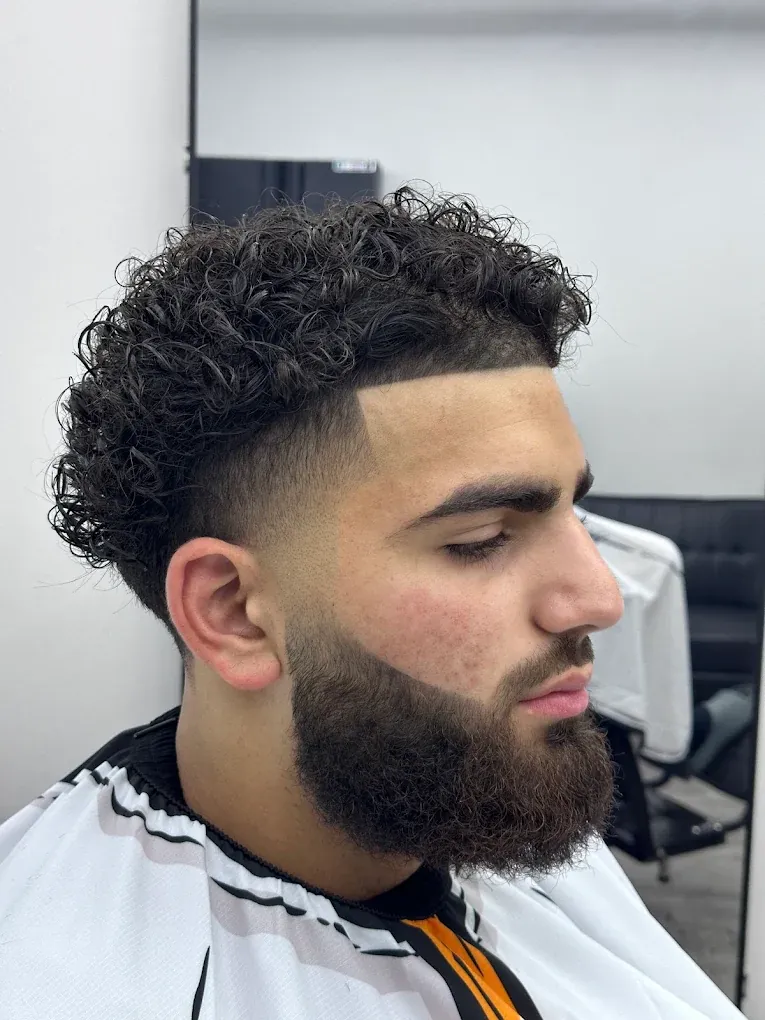
- Beard with a skin fade: the most requested combination in our shop. The fade at the sideburn should blend seamlessly into the beard, with no visible step.
How often should you trim a beard?
Shape and length are two different jobs, and they run on different clocks.
- Stubble: reset every 3–5 days.
- Short beard: a shape-up every 2 weeks.
- Medium to full beard: professional line-up every 2–3 weeks, plus light stray trimming at home.
- Growing it out: still come in every 2–3 weeks. Maintaining shape while gaining length is exactly what a barber is for — skipping trims does not make a beard grow faster, it just makes it grow shapeless.
Tools that are actually worth owning
- A trimmer with adjustable guards, ideally in half-millimeter steps.
- A boar-bristle beard brush for training direction, plus a wide-tooth comb for longer beards.
- Beard wash — not bar soap or standard shampoo, both of which strip the oils that keep the hair soft.
- Beard oil for skin and shine; beard balm when you need light hold and frizz control.
- Small sharp scissors for the mustache and the occasional rogue hair.
A daily and weekly beard care routine
Daily: rinse in the shower, towel to damp, brush down and out to train growth direction, then apply a few drops of oil while the hair is still warm so it spreads to the skin underneath.
2–3 times a week: beard wash, followed by conditioner or balm on longer beards.
Weekly: scan for strays above the cheek line and under the jaw, and trim only those. Leave the actual lines alone if you are seeing a barber on schedule.
Patchy growth, itch and beardruff
Patchy cheeks: give it 4–6 weeks before judging. Density often fills in as surrounding hair lengthens and lays over thin spots. If it does not, go shorter and more uniform — short beards hide patchiness, long ones advertise it.
Itch: almost always dry skin, not the hair. Oil the skin, not just the beard, and wash less often with harsh products.
Flaking (“beardruff”): brush to lift dead skin, then oil. If it persists past a few weeks, it may be seborrheic dermatitis and worth a doctor’s look.
Ingrown hairs and razor bumps: common with tight necklines on coarse or curly hair. Shave with the grain, keep the line slightly lower, and never dry-shave the neck.
Beard care in Louisiana humidity
Denham Springs summers work against a beard. Humidity swells the hair shaft and creates frizz, and sweat plus product buildup irritates the skin underneath. Switch to a lighter oil in July and August, wash more often but with a gentler product, and use balm sparingly — heavy waxes trap sweat. Rinsing the beard after time outdoors does more for it than any product.
Growing a beard out: a realistic timeline
- Weeks 1–2: awkward and itchy. Do nothing but keep the neckline clean.
- Weeks 3–4: first real shape-up. Neckline and cheek line only, no length removed.
- Weeks 5–8: patchiness starts filling in. Begin light length work to even the perimeter.
- Months 3–6: the beard has a shape worth maintaining. Now length trims matter, and a barber’s eye keeps both sides symmetrical in a way a mirror cannot.
Common questions
Should I trim my beard wet or dry? Dry. Wet hair stretches and you will cut shorter than you intended.
Can I fix a neckline I took too high? Not directly — it has to grow back, usually 2–3 weeks. In the meantime a barber can rebalance the rest so it is less obvious.
Does shaving make a beard grow thicker? No. It blunts the tips so regrowth feels coarser, but density and growth rate do not change.
How long does a beard trim take? A shape-up runs about 15–20 minutes; a full beard sculpt with a hot towel and razor line-up takes closer to 30.
Book a beard trim in Denham Springs
If you have ever regretted a home neckline, that is the job to hand off. Our barbers do beard shape-ups, razor line-ups and full beard sculpts daily at 2570 Florida Blvd Ste B in Denham Springs, and you can book online with the barber of your choice.